Happy Diwali!
Ah... Diwali. The festival of lights...and the sharp ratta-tat-tat of "bombs" exploding.
All kidding aside, Diwali is my favorite Indian holiday. It's like the 4th of July and Christmas had a baby... a big, fireworks and sweet laden baby.
This particular holiday marks the return of Rama and Sita after fourteen years of exile and the defeat of Ravana (as in Evil Demon King Ravana). Lights, particularly these little clay pots called "diyas," play a big part in the celebrations. In mythology, Rama's people were so happy for his return that they lit Rama's way with these little diyas and set off firecrackers in celebration. Nowadays, people set off firecrackers and fireworks of all calibers, buy new clothes, and go visiting with sweets in hand.
It's fabulous.
Here's proof.




And... for your entertainment... a video. (I'm sorry it's sideways...)
All kidding aside, Diwali is my favorite Indian holiday. It's like the 4th of July and Christmas had a baby... a big, fireworks and sweet laden baby.
This particular holiday marks the return of Rama and Sita after fourteen years of exile and the defeat of Ravana (as in Evil Demon King Ravana). Lights, particularly these little clay pots called "diyas," play a big part in the celebrations. In mythology, Rama's people were so happy for his return that they lit Rama's way with these little diyas and set off firecrackers in celebration. Nowadays, people set off firecrackers and fireworks of all calibers, buy new clothes, and go visiting with sweets in hand.
It's fabulous.
Here's proof.
 | |
| Diya |

 |
| Fountain! |
 |
| Whirlygig! |
 |
| More fountain action! |


 |
| Sparklers! |



 |
| The roof-top crew... we set off BIIIIG fireworks! |

And... for your entertainment... a video. (I'm sorry it's sideways...)

Happy Halloween!
I love Halloween.
Love.
When we were children, my mother helped us make the most extravagant and exquisite costumes. I don't ever remember wearing store bought costumes--we always had to use our imagination and whatever stuff we had laying around. One year, for example, my sister went as a giant spider. Most of the legs were attached by strings so when she moved an arm, ALL the legs moved. It was fantastic.
Steve worked really hard to make Halloween happen for me this year. He bought a pumpkin from Veena-bhen (our vegetable lady) and spent well over an hour carving it. He even METICULOUSLY picked the goo off the pumpkin seeds so I could roast them because he knows how much I love roasted pumpkin seeds.
Later, he'll suffer though Rocky Horror Picture Show.
We spent all last night and most of today making decorations for the smattering of kids that showed up to trick-or-treat. The kids came, ate/pocketed THIRTY-TWO Halloween-sized candy bars, drank about two liters of soda, watched Thriller (howling and hooting at the appropriate moments), and then left.
It was fabulous.
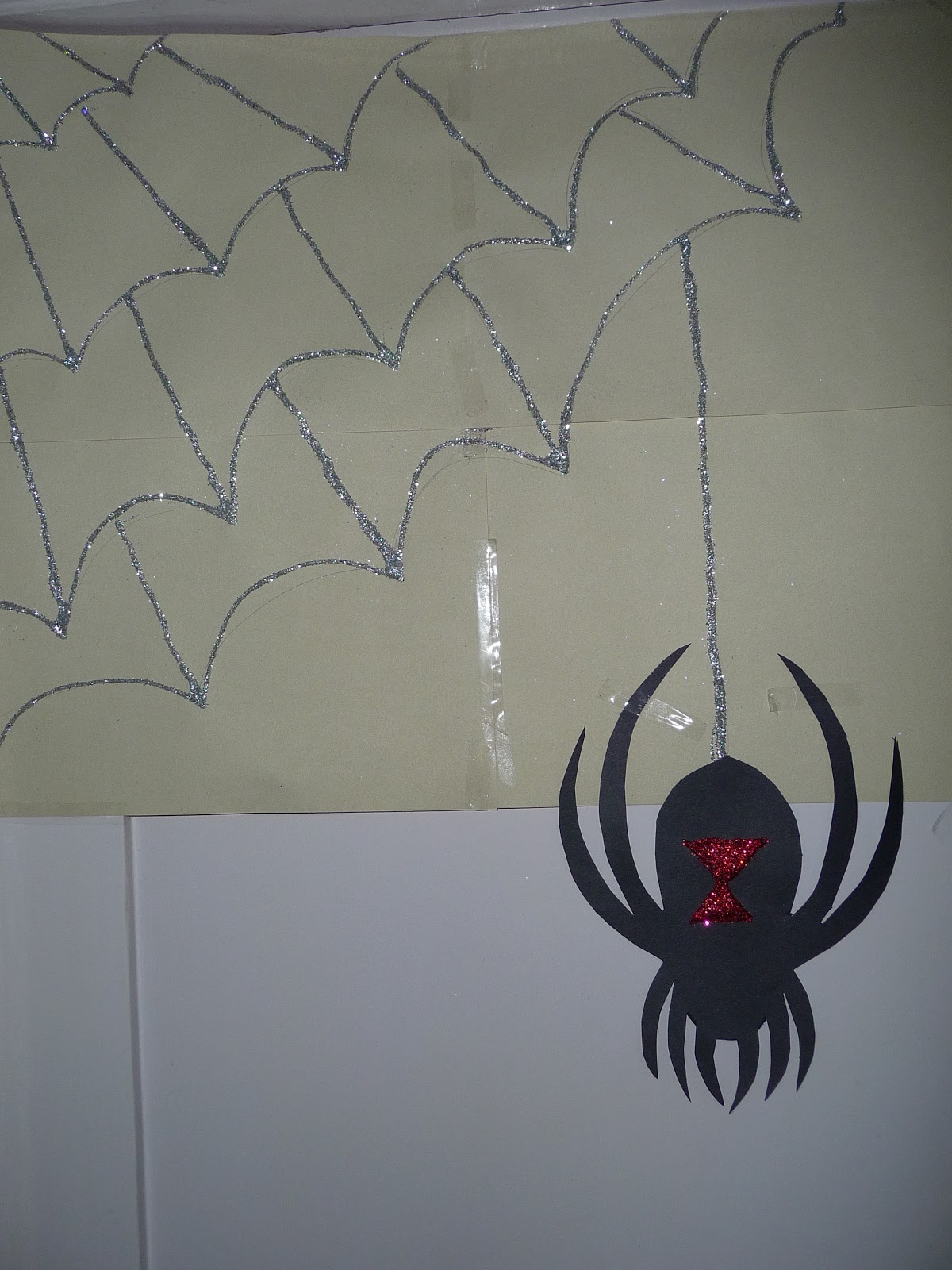
Now, we're watching horror movies under a ceiling full of dancing bats and ghosts.
Happy Halloween, y'all.
 |
| Be my Frankenstein! |
 |
| Necessity is the mother of invention--construction paper held together with floss! I'm a Halloween MacGuyver! |

 |
| Tissue and floss... |
 |
| Upside down pumpkin man--his bottom was too round. He was a big, BIG hit with our visitors. |
 |
| Glue wasn't quite dry on this one when we hung it... |
 |
| ah-OOOOO! Werewolves of A-bad! |
 |
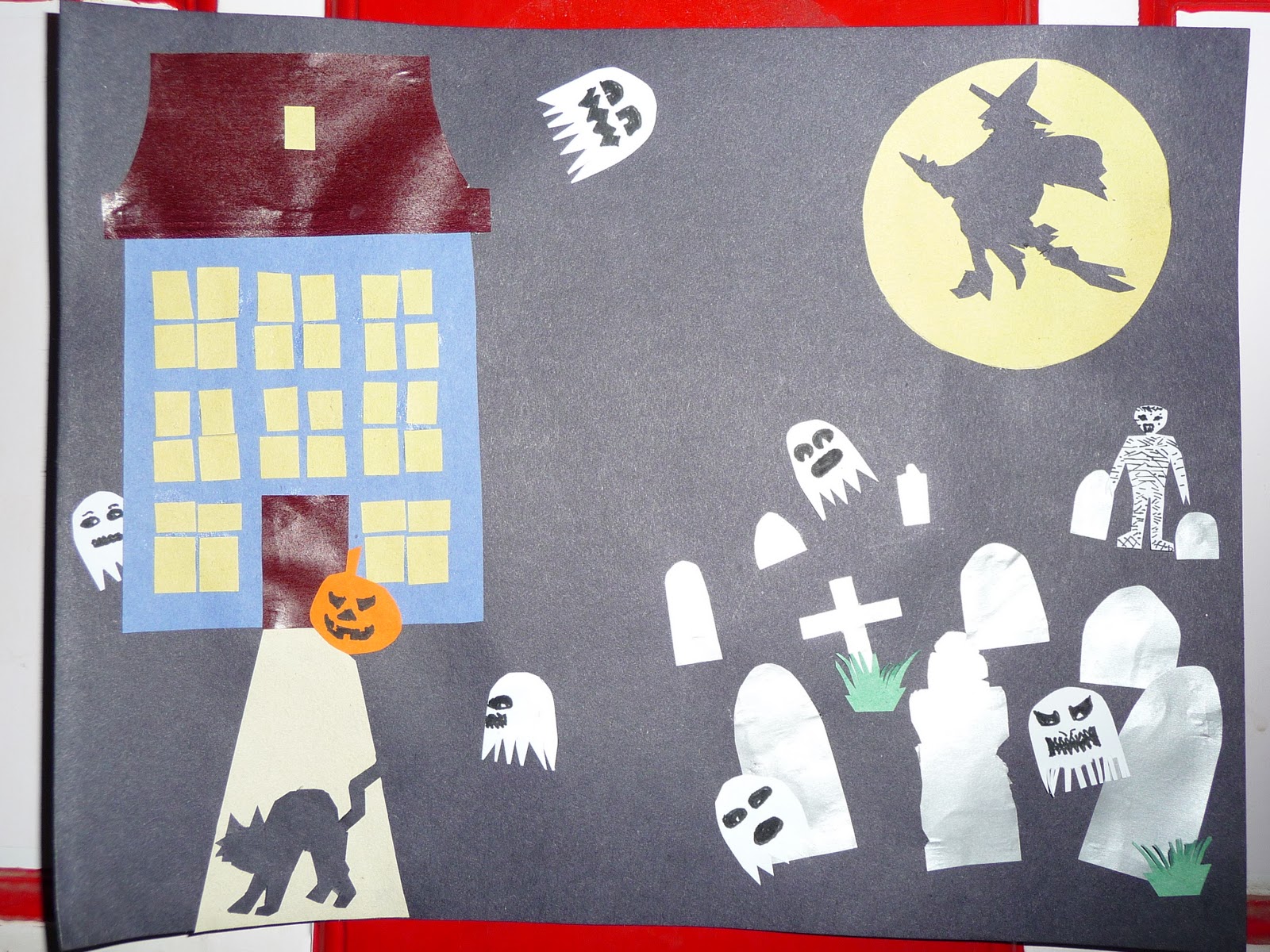
| And the piece de resistance... Steve's the master of the art of collage. (It took him BOTH DAYS to make this... because he's that meticulous. Seriously, look at the ghosts' faces, the grass, the witch and cat, the MUMMY). |
 |
| Ah... the crew! |
 |
| Happy Halloweenie! |
Happy 141st, Gandhiji!
In addition to being Gandhi's 141st birthday (October 2nd), this year also marked the 75th anniversary of Gandhi's Salt March. For those of you not as versed in Indian history, Gandhi devised the Salt March as a peaceful protest against the British Raj's unfair Salt Tax (instituted in 1882). In essence, what the Salt Tax did was outlaw not only the production and sale of salt by non-British entities, but made it unlawful for workers to freely collect their own salt from the marshes peppered along the Indian coastal line. Essentially, the British created a monopoly from which only they benefited.
In response, Gandhi first wrote a letter to the British Viceroy informing him of his intent to protest:
And so, on March 12, 1930 Gandhi and a number of his followers gathered at his ashram (men only as he felt that including women would not elicit the same--hopefully--violent response from law-enforcement) began the 23-day march from his ashram on the west bank of the Sabarmati River in Ahmedabad to the coast. Upon reaching their destination, Dandi, Gandhi gave a speech and then did something that would inspire a nation.
He bent, perhaps ran his hands over the rich earth, fingers searching before plucking a small lump of salt from the ground. With this simple gesture, Gandhi broke British law.
His fellow protesters followed suit, and, over the course of the next month, nearly each and every one of them--including Gandhiji himself--were arrested and thrown in prison.
But the damage was done. The Salt March encouraged the people to protest, and protest they did. Some ended in violence when peaceful marchers, refusing to respond to threats of violence, were clubbed to death by armed policemen. Others were peaceful boycotts. Either way, a number of British salt mills and shops were forced to close and the seed of revolution was planted in the people's minds and hearts.
I was thinking of this on Wednesday when Steve and I visited the Hutheesing Center on CEPT's campus. The gallery is hosting an exhibit called "Mahatma: The Youthful Perspective", a series of full size/nearly full-sized images of Gandhi created by artist Debanjan Roy. The artist modeled each of the statues after a pre-existing image of Gandhi and attempted to capture the spirit of Bapu (meaning "father"; the name that Gandhi's friends and associates affectionately called him) as well as that of modern 21st century India. The artist describes his exhibit thus:

Now, here's the thing. I'm not overly fond of symbolic art (and I'm even less fond of artist's "notes" that feel the need to explain the symbolism of their installation--I have eyes, I can see, and I'm pretty educated so I like to draw my own conclusions, thank you very much). However, I do like thought provoking art. This exhibit was a little bit of both. Take a look:




In response, Gandhi first wrote a letter to the British Viceroy informing him of his intent to protest:
If my letter makes no appeal to your heart, on the eleventh day of this month I shall proceed with such co-workers of the Ashram as I can take, to disregard the provisions of the Salt Laws. I regard this tax to be the most iniquitous of all from the poor man's standpoint. As the Independence movement is essentially for the poorest in the land, the beginning will be made with this evil.The Viceroy responded, informing Gandhi that Britian's stance on the tax remained firm.
And so, on March 12, 1930 Gandhi and a number of his followers gathered at his ashram (men only as he felt that including women would not elicit the same--hopefully--violent response from law-enforcement) began the 23-day march from his ashram on the west bank of the Sabarmati River in Ahmedabad to the coast. Upon reaching their destination, Dandi, Gandhi gave a speech and then did something that would inspire a nation.
He bent, perhaps ran his hands over the rich earth, fingers searching before plucking a small lump of salt from the ground. With this simple gesture, Gandhi broke British law.
His fellow protesters followed suit, and, over the course of the next month, nearly each and every one of them--including Gandhiji himself--were arrested and thrown in prison.
But the damage was done. The Salt March encouraged the people to protest, and protest they did. Some ended in violence when peaceful marchers, refusing to respond to threats of violence, were clubbed to death by armed policemen. Others were peaceful boycotts. Either way, a number of British salt mills and shops were forced to close and the seed of revolution was planted in the people's minds and hearts.
I was thinking of this on Wednesday when Steve and I visited the Hutheesing Center on CEPT's campus. The gallery is hosting an exhibit called "Mahatma: The Youthful Perspective", a series of full size/nearly full-sized images of Gandhi created by artist Debanjan Roy. The artist modeled each of the statues after a pre-existing image of Gandhi and attempted to capture the spirit of Bapu (meaning "father"; the name that Gandhi's friends and associates affectionately called him) as well as that of modern 21st century India. The artist describes his exhibit thus:

Now, here's the thing. I'm not overly fond of symbolic art (and I'm even less fond of artist's "notes" that feel the need to explain the symbolism of their installation--I have eyes, I can see, and I'm pretty educated so I like to draw my own conclusions, thank you very much). However, I do like thought provoking art. This exhibit was a little bit of both. Take a look:
 | |
| Bapu with iPod |
 |
| Bapu and Me |
 | ||
| It doesn't show well, but the artist--the "me" in the title--is sharing his iPod with Gandhiji |
 |
| I don't remember the title of this one, but we called it Bapu the Hipster |
 |
| A close-up of Bapu's Pug |

 |
| Bapu with Goats (this one is probably the most iconic-like representation of Gandhiji in the whole collection) |
 |
 |
| Bapu on the Moon |
 | |||
| Bapu on the Phone |
 |
| Bapu and Soldiers (It might be hard to see, but the two soldiers have the same name tag, Debanjan Roy) |
 |
| Bapu with Laptop |


 |
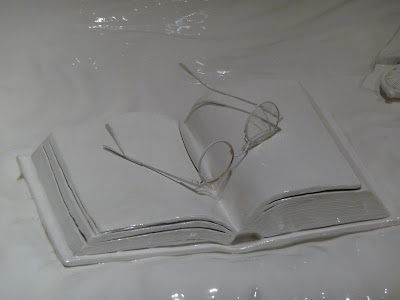
| Absence of Bapu (this one was, perhaps, the most symbolic of all the pieces) |


 |
| The "See No Evil, Hear No Evil, Speak No Evil" monkeys are above the gate at Gandhi's ashram |

When people visualize Gandhi, I would hazard the first image that comes to mind is that of a thin, frail-looking, blad-headed old man wrapped in a white cloth, wire rimmed spectacles perched on his nose. This image is also highly representative of the way people intellectualize Gandhi's teachings--truth and nonviolence. Here is an unassuming man--he is not muscular, and thus non-threatening (in the physical sense)--who desires discourse over violence, intellect over brute force.
Despite Gandhi's renunciation of worldly goods in pursuit of these two principles, it is important to emphasize that Gandhi's simplified life was NOT a rebuke of modern life or modern things. In fact, Gandhi was a big proponent of using the trappings of modern life--and especially modern techniques of communication--to emphasize and relay his teachings. It is Roy's depiction of Gandhi interacting with our modern technologies--the cell phone, the iPod, the laptop--that is perhaps the most indicative of Gandhi's appreciation of science and technology. It is, therefore, not difficult to imagine Bapu updating his status on Facebook, rallying his followers on Twitter, or creating podcasts of his latest speeches.
But it is also important to recognize that Gandhi would have instructed us to not become the sum of our things. We are not our Facebook pages or our Twitter handles; we are living, breathing, vibrant people. Furthermore, he would encourage us to disengage from the technologies--log off the computer, remove the iPod buds from our ears--and engage with the world outside our technological cocoon.
I've often wondered what Gandhi would think of how his image and teachings are used. I often think, especially here in India, that he would be sad at how easily his name and image are grossly contorted by individuals and groups who aren't living Gandhian principles. However, I couldn't help but think that if Gandhi were able to see Debanjan Roy's statues, with their mixture of playfulness and seriousness melding to create a message not unlike that that Gandhi preached, Bapu would be pleased.
And By the Way...
If getting here weren't enough of a... challenge I give you THE UNIDENTIFIED AND MYSTERIOUS (but most likely poison ivy) RASH
doom doom, doom doom, doom doom, doooooommmm
 Inside the elbow pit...

On the upper hip...

Left forearm....
 Close-up of left forearm...
 Right forearm (dunno if you can see it, but there's a... carter in the middle of this one)
Gross, I know. And, as an added bonus, SUPER ITCHY. Like, wake up in the middle of the night to find myself scratching... myself. *Sigh*
doom doom, doom doom, doom doom, doooooommmm


On the upper hip...

Left forearm....


Gross, I know. And, as an added bonus, SUPER ITCHY. Like, wake up in the middle of the night to find myself scratching... myself. *Sigh*