Picture Pages, Picture Pages (WARNING: PICTURE HEAVY)
In lieu of a "serious" blog post, I give you pictures (cause really, who doesn't like visuals?)! While attending the Fulbright conference in Udaipur, we rented a car for a day trip to the Ranakpur Jain Temple (the Jains are the group that Steve studies, more (basic) information may be found here or feel free to contact Steve). This temple, in comparison to others built in/around the same time (late 14th to early 15th Century--it took about 63 years to complete most of the structure, some parts of the temple remain unfinished merely roughed out sketches of where carvings should go in the white marble pillars and ceilings), is unique in its construction. Most Hindu/Jain temples of this period are dark in the inside, as they are built as fully enclosed structures (four walls and a roof). However, Ranakpur temple is built in three tiers with each tier carved in such a way as to let in as much light as possible. The great Moghul emporer Akbar was so entranced by the beauty of the temple, he made an edict, which is set in stone outside the temple, that no one should ever destroy this marvel of architecture. More recently, the Jain temple at Ranakpur was voted as one of the top 77 "New Marvels of the World" in a competition sponsored by National Geographic.


 Detail of ceiling


 Finished ceiling and...
 Unfinished ceiling.


The following images are Steve's favorite portion of the temple. These round disks (carved out of a very thick, heavy piece of marble) are representations of Nandishvara (the mythical continent at the edge of the universe). There 52 Jain temples (represented by the "houses") which only the gods may make pilgrimage. The cone shaped thing in the middle of the circle is representative of continents and oceans of our portion of the universe. The very center of that cone is Mount Meru, or the axis point around which the entire universe spins. The trees are wish-fulfilling trees.


 This is my favorite column (no two columns are alike, supposedly. There are far too many to, in 3-5 hours, to ascertain whether or not this statement is true). The pictures that follow are close-up details of the figures (from top to bottom they are: a devotee, a kirtimukha (a figure that wards off evil), an elephant, a horse, a goose, and a lion)


And finally, Steve and I pose for the obligatory touristy picture in front of the temple:


Detail of one of the (many) ceiling pendants. That's all hand carved folks... all hand carved.

Detail of the top of one of the over 400 columns that support the multi-tiered temple.
Detail of ceiling 

This image of the Jina Parshvanath is the most famous image from this particular temple. The figures standing to the immediate left and right of the Jina are a man and a woman (possible significance=patrons?). The figures to the extreme left and right of the Jina are naga (snake) attendants. The nagas are a race of subterranean semi-divine beings who are worshiped widely in India and present in many different Indian texts. The umbrella structure over the Jina and these other figures is actually a 1,000 headed (be my guest, count them if you want!) cobra. If you look closely within the twisty parts (which are actually continuously entwined naga tails), there are more naga ladies sprinkled throughout.

A (very) small representation of the number, style, and construction of pillars within the temple

Detail at the bottom of a door
Finished ceiling and...Unfinished ceiling.
Ceiling of a different variety

Detail of outside of temple

The carvings are quite marvelous--they go back into the corners (as you an see here) and are actually carved in the round (meaning they're carved ALL the way around the figure)


A god and goddess all decked out, and a snake in a box (not a real snake...)

A temple pujari (pujaris are ritual officiants--they help maintain the temple, make sure all the necessary items for worship are stocked/on hand, and perform rituals if no laypeople are present to do so).

Indra, King of the Gods. Indra is the ideal male devotee; Indra was the first to bathe the Jina post-birth, thus establishing the model for lay ritual.

Brahma (often called the Creator God; ironically, the Jains do not believe the world was created but rather it always existed so Brahma's inclusion on one of the pillars of this temple is interesting.)

I call this "You hurt my toe, now I kill you!" (note the sword this lovely lady is holding in her hand...)
The following images are Steve's favorite portion of the temple. These round disks (carved out of a very thick, heavy piece of marble) are representations of Nandishvara (the mythical continent at the edge of the universe). There 52 Jain temples (represented by the "houses") which only the gods may make pilgrimage. The cone shaped thing in the middle of the circle is representative of continents and oceans of our portion of the universe. The very center of that cone is Mount Meru, or the axis point around which the entire universe spins. The trees are wish-fulfilling trees.


Here's some perspective just how tall these columns are... this picture ends about 2/3 of the way up the column. These columns, however, are not one solid piece of marble. Rather, they are sections, individual carved, and then placed on top of each other. The craftsmanship is so fine, however, that you can barely detect where one piece of marble is laid atop the other.

A portion of a column. I believe this image is supposed to represent a lotus flower.


This column was unique (as far as I could tell) as it was the only column in the entire temple that included a single elephant head vs. a complementary elephant figure on the opposite side of the column.

Detail of ceiling--note that these guys are half man, half bird. Also note, their tails (those squiggly things behind them) appear to come out of their bellybuttons... Steve is kerflummoxed.

Dude and Naga Ladies--sort of reminiscent of the Jina, his umbrella of cobra heads, and many, many Naga ladies...

I took over one hundred pictures of the Jain temple at Ranakpur--so many in fact, I killed my camera battery and was unable to take photos of the two lesser (in size alone!) Jain temples and one Surya (Sun) temple at the complex (which is actually rather unfortunate as there were some interesting and unique elements present at/on these temples as well). Please visit my Photobucket slide show on the front page of my blog for a full complement of the pictures as well as a video of Steve explaining the elements of the famous and iconic circular Jinna image.
Baroda: Lakshmi Villas Palace
Baroda, a.k.a. Vadodara, is a small city situated just south of Ahmedabad. The view from a rickshaw window produces sights not dissimilar to those of Ahmedabad. People, women mostly, bustle in and out of a number of shopping plazas and malls interspersed with other smaller shops selling everyday goods. An occasional cow meanders down the road, and dogs loll sleepily in what little shade vegetable vendors' carts provide. Cars whiz by, scooters honk at bicyclists and auto-rickshaws alike, pedestrians play real-life game of Frogger as they weave in and out of this cacophonous chaos.
And yet, there are things that make this small city stand apart from its larger counterpart. The streets appear more orderly; there seems to be a system beyond the suicidal inching of a vehicle's nose into the stream of traffic and honking like a mad man. Traffic moves at an acceptable pace and in an orderly manner. And, if sight is to be trusted, there even seems to be an adherence to the red, yellow, and green of traffic lights! Additionally, Baroda has rehabilitated its crumbling old havelis*, the former architectural grand dames of society housing, into a semblance of their former palatial beauty. Instead of the pampered children running through hallways, or ladies of the house taking tea by the courtyard fountain, these buildings now house banks, city offices, and museums. In comparison, a number of Ahmedabad's havelis sit neglected; beautiful and damaged pieces of history rotting right next to concrete rectangles and squares, modern monstrosities that pass as fashionable housing these days.
Lakshmi Vilas Palace, however, is a different kind of "home" that attests to the rich lifestyle of its former (and current) occupants: The Gaekwads, Gujarat's own royals**. Like any royal family, the Gaekwad's history is dotted with triumphs, tragedies, and scandals. They ruled from approximately the mid-1700s to 1947 when the India won its independence from the British (the Gaekwads relinquished their rule to the newly democratic India as they no longer had the support of their British allies who, for a fee, had let them continue to rule Baroda as an princely state during British colonization). The name remains "princely" in nature (and the family still inhabits a portion of the palace) but they hold no power.
Perhaps one of the more colorful members of this family is Maharani Sita Devi. Known as the Wallis Simpson of India, Sita Devi and the Maharajah cooked up a plan that would allow the married Sita Devi to wed the married Muslim king: Sita Devi, a Hindu, would convert to Islam and wed the king. This conversion and subsequent marriage, under law, would dissolve her first marriage. Second hurdle: circumnavigating the anti-bigamy law (a law backed by the British) that the Maharajah himself had signed into being. In love, haughty and wily royalty, whatever the reason, the king was able to successfully argue that as Maharajah of Baroda, he was above the law, as law was meant to govern the people and not the ruling class. And thus, a fairly common woman became the second living wife of a king (though the British elite refused to ever address her as "Maharani" or Your Highness). Sita Devi's story, however, is full of love and light and laughter--and a touch of scandal. As the reign of the Gaekwads came to an end, her husband set Sita Devi up in a lavish house in Monte Carlo. Ever so slowly, the Maharajah started to secretly "gift" his wife monies and jewels including the Baroda Pearls and the Star of the South. When the new government of Baroda discovered this, they attempted to regain some of these valuables, and were successful to a degree. However, the Maharajah was smart enough to sign a number of these jewels over to his wife (thus transferring their ownership) and the Maharani herself had a number of these items re-set into smaller pieces. Later, as the Maharani aged and her funds dwindled, she sold these pieces in secret auctions to help support herself.
These, and others, are the lives that unfolded withing the walls of Lakshmi Vilas Palace. The Palace itself was commissioned by Maharajah Sayajirao Gaekwad III and building commenced in/around 1880 and was completed in 1890 (this becomes an impressive span of time when you take into consideration the scope and magnitude of this particular project). The first architect who worked on this particular project committed suicide--he did not believe that he had created a building that, upon completion, would maintain its structural soundness. However, it is almost 100 years later, as seen in the pictures below, the structure is still strong.
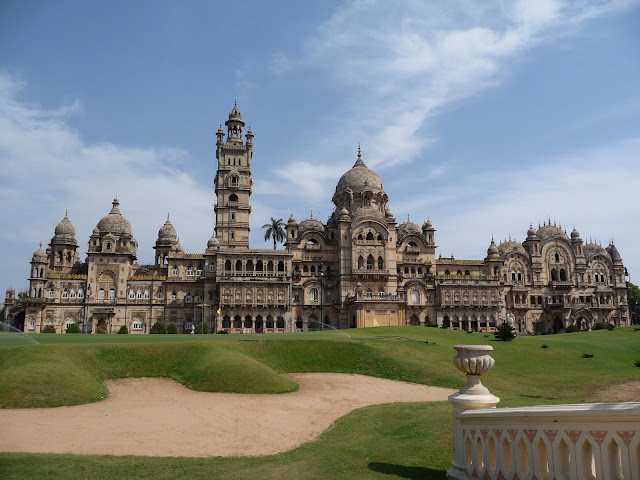 One of the many fascinating aspects of this particular palace is its size--it is (arguably) the largest palace built in its time (the 19th Century) and is roughly four times the size of Buckingham Palace.The Lakshmi Vilas Palace is unique among the (many) palaces of India because of the way its architecture incorporates the European and the Asian--look closely at the picture above and note that there are three distinct sections to this palace. On the right, a domed shaped building reminiscent of Muslim mosque architecture, the center (with its tall "bell tower"--which the architect decided was a terrible idea as the bell would keep everyone awake, thus they replaced the bell with a lamp that is light when the Maharajah is home) Christian, and the far left Hindu. A closer look:


The outside of the building as well as some of the interior spaces contain very intricate stone statues and carvings and Venetian mosaic tile art. All of this type of structure and art was created by imported Italian artisans. (For more detailed pictures, please see my Photobucket account--just click on the viewer on the bottom left of the front page of the blog).
I have a fondness for palaces and the history contained within their walls, and in that sense the audio portion of the tour didn't disappoint. Factiods that floated from the earbuds to my ears included snippets of the last Maharajah's recollections of his childhood (his father was strict and emphasized the importance of education and responsibility over wealth and privilege), the current Maharajah is pursuing a PhD with an emphasis on the role and use of ceremonial hats, and once upon a time the Maharajah's dipped their water-tempered steel swords (a process that produces a near-paper thin blade that one might not even feel pierce the skin) in poison. What is fascinating is who and what is included in the history of this palace as it is presented to and consumed by tourists. The Gaekwads as benevolent protectors ("gaekwad' actually translates loosely as "protector of the cows" as the region was originally populated by such people) and enlightened rules who encouraged and developed education and the arts; what is not narrated are the moments in which the Gaekwads may have acted as despots, or when they were less then benevolent. Nor are the "scandals" discussed (such as that of Sita Devi). There is a certain picture that the current royals wished depicted and maintained, damn the rest of history! If walls, these gloriously tiled and marble walls could talk, I would gladly listen for hours. Their story, their collective stony memory, must far surpass the anecdotal history of an audio guide.
*Haveli is a Persian word meaning "enclosed place" and is the word used in India (and Pakistan) to describe private mansions. Haveli architecture of India (and Pakistan) varies from region to region but typically are large, ornate structures built around at least one central courtyard. This courtyard may or may not contain a fountain. Some of the oldest havelis date back to the Mughal period.
**For a brief history of the Gaekwads, see this link.
And yet, there are things that make this small city stand apart from its larger counterpart. The streets appear more orderly; there seems to be a system beyond the suicidal inching of a vehicle's nose into the stream of traffic and honking like a mad man. Traffic moves at an acceptable pace and in an orderly manner. And, if sight is to be trusted, there even seems to be an adherence to the red, yellow, and green of traffic lights! Additionally, Baroda has rehabilitated its crumbling old havelis*, the former architectural grand dames of society housing, into a semblance of their former palatial beauty. Instead of the pampered children running through hallways, or ladies of the house taking tea by the courtyard fountain, these buildings now house banks, city offices, and museums. In comparison, a number of Ahmedabad's havelis sit neglected; beautiful and damaged pieces of history rotting right next to concrete rectangles and squares, modern monstrosities that pass as fashionable housing these days.
Lakshmi Vilas Palace, however, is a different kind of "home" that attests to the rich lifestyle of its former (and current) occupants: The Gaekwads, Gujarat's own royals**. Like any royal family, the Gaekwad's history is dotted with triumphs, tragedies, and scandals. They ruled from approximately the mid-1700s to 1947 when the India won its independence from the British (the Gaekwads relinquished their rule to the newly democratic India as they no longer had the support of their British allies who, for a fee, had let them continue to rule Baroda as an princely state during British colonization). The name remains "princely" in nature (and the family still inhabits a portion of the palace) but they hold no power.
Perhaps one of the more colorful members of this family is Maharani Sita Devi. Known as the Wallis Simpson of India, Sita Devi and the Maharajah cooked up a plan that would allow the married Sita Devi to wed the married Muslim king: Sita Devi, a Hindu, would convert to Islam and wed the king. This conversion and subsequent marriage, under law, would dissolve her first marriage. Second hurdle: circumnavigating the anti-bigamy law (a law backed by the British) that the Maharajah himself had signed into being. In love, haughty and wily royalty, whatever the reason, the king was able to successfully argue that as Maharajah of Baroda, he was above the law, as law was meant to govern the people and not the ruling class. And thus, a fairly common woman became the second living wife of a king (though the British elite refused to ever address her as "Maharani" or Your Highness). Sita Devi's story, however, is full of love and light and laughter--and a touch of scandal. As the reign of the Gaekwads came to an end, her husband set Sita Devi up in a lavish house in Monte Carlo. Ever so slowly, the Maharajah started to secretly "gift" his wife monies and jewels including the Baroda Pearls and the Star of the South. When the new government of Baroda discovered this, they attempted to regain some of these valuables, and were successful to a degree. However, the Maharajah was smart enough to sign a number of these jewels over to his wife (thus transferring their ownership) and the Maharani herself had a number of these items re-set into smaller pieces. Later, as the Maharani aged and her funds dwindled, she sold these pieces in secret auctions to help support herself.
These, and others, are the lives that unfolded withing the walls of Lakshmi Vilas Palace. The Palace itself was commissioned by Maharajah Sayajirao Gaekwad III and building commenced in/around 1880 and was completed in 1890 (this becomes an impressive span of time when you take into consideration the scope and magnitude of this particular project). The first architect who worked on this particular project committed suicide--he did not believe that he had created a building that, upon completion, would maintain its structural soundness. However, it is almost 100 years later, as seen in the pictures below, the structure is still strong.


(The Muslim portion--this is where the royal family currently lives and structural resembles the zenana, or women's quarters of more famous Muslim palaces)

(The Christian-inspired bell tower)

(This section resembles a Hindu palace's sabha, or audience hall. Here is where the Maharajahs preformed portions of their public duties. This section also housed the ballroom, with its stain-glassed windows and mosaic tiled floor that took year and a half to hand-lay all of the tiles in intricate designs.)
The outside of the building as well as some of the interior spaces contain very intricate stone statues and carvings and Venetian mosaic tile art. All of this type of structure and art was created by imported Italian artisans. (For more detailed pictures, please see my Photobucket account--just click on the viewer on the bottom left of the front page of the blog).
I have a fondness for palaces and the history contained within their walls, and in that sense the audio portion of the tour didn't disappoint. Factiods that floated from the earbuds to my ears included snippets of the last Maharajah's recollections of his childhood (his father was strict and emphasized the importance of education and responsibility over wealth and privilege), the current Maharajah is pursuing a PhD with an emphasis on the role and use of ceremonial hats, and once upon a time the Maharajah's dipped their water-tempered steel swords (a process that produces a near-paper thin blade that one might not even feel pierce the skin) in poison. What is fascinating is who and what is included in the history of this palace as it is presented to and consumed by tourists. The Gaekwads as benevolent protectors ("gaekwad' actually translates loosely as "protector of the cows" as the region was originally populated by such people) and enlightened rules who encouraged and developed education and the arts; what is not narrated are the moments in which the Gaekwads may have acted as despots, or when they were less then benevolent. Nor are the "scandals" discussed (such as that of Sita Devi). There is a certain picture that the current royals wished depicted and maintained, damn the rest of history! If walls, these gloriously tiled and marble walls could talk, I would gladly listen for hours. Their story, their collective stony memory, must far surpass the anecdotal history of an audio guide.
*Haveli is a Persian word meaning "enclosed place" and is the word used in India (and Pakistan) to describe private mansions. Haveli architecture of India (and Pakistan) varies from region to region but typically are large, ornate structures built around at least one central courtyard. This courtyard may or may not contain a fountain. Some of the oldest havelis date back to the Mughal period.
**For a brief history of the Gaekwads, see this link.

